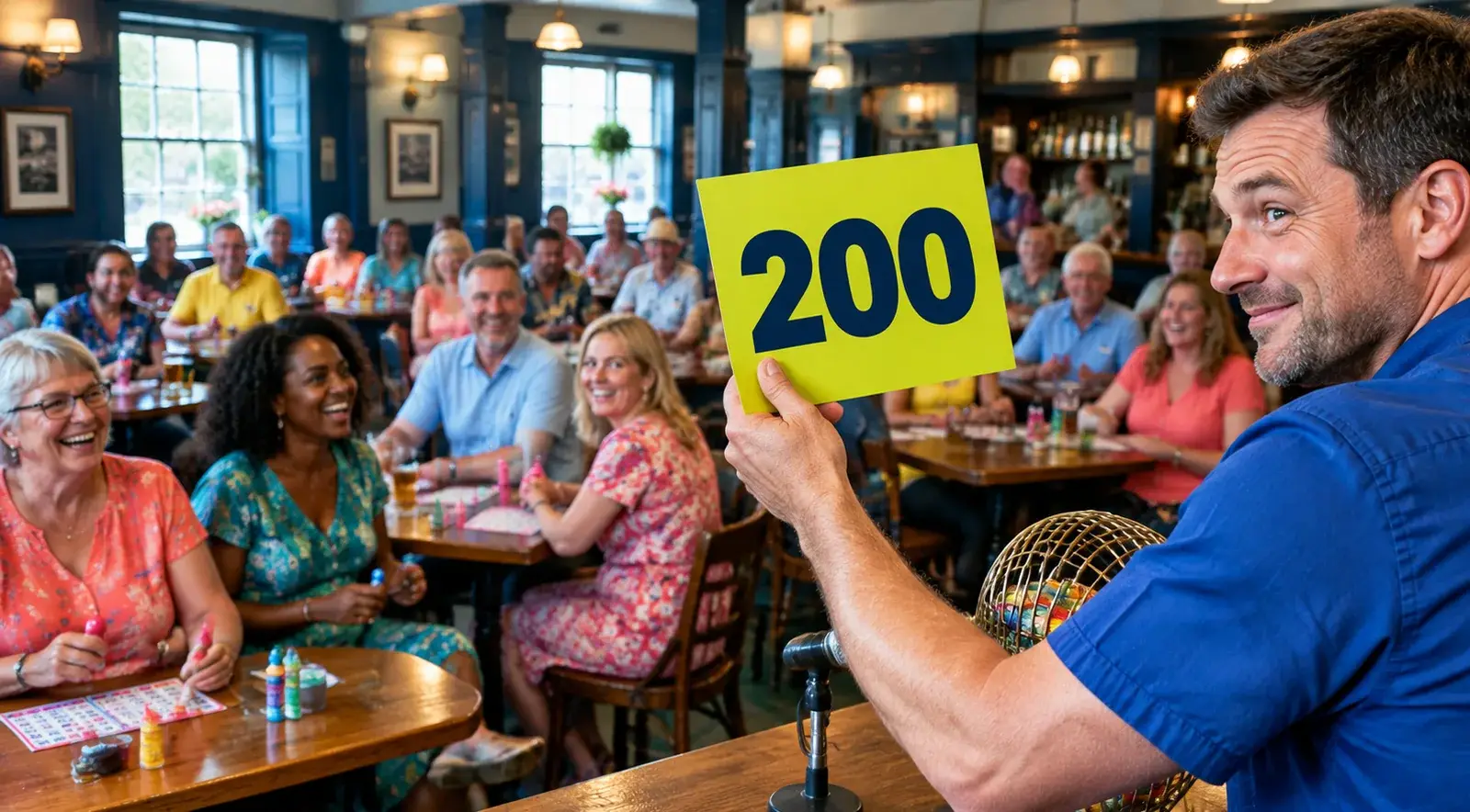
Counting to 200 sounds easy until you try it in a real building.
People arrive late and leave early. Someone steps out for a cigarette. A parent takes a crying toddler outside. The caterers come and go through the side door, and the volunteers who put the chairs out at six have gone home by the time the room is full.
Ask three people how many were in on Saturday night and you'll get three different answers.
Yet that's the number Martyn's Law turns on.
The short answer: the law applies if 200 or more people, staff and volunteers included, can reasonably be expected to be at your premises at the same time, at least occasionally.
So it's not everyone who came through the door that day. It's not your average, and it's not a one-off. It's your realistic busy-time peak, worked out in a way you can explain if the regulator asks.
Getting it wrong costs you either way. Count too high and you do work you didn't need to. Count too low and you're out of line with the law when it starts.
This guide covers how the Home Office says to count, the mistakes we see most often, and four worked examples.
Key takeaways
- The test is the greatest number reasonably expected at the same time, from time to time. Peaks count; averages don't.
- Everyone counts: visitors, staff, volunteers and contractors.
- The Home Office lists six accepted ways to work it out, including your fire safety occupancy figure and your own attendance records.
- A genuine one-off doesn't bring you into scope. A regular busy night or yearly event does.
- Write down how you got your number. The regulator can ask how you did it.
What exactly is being counted?
The Home Office sets the test as "the greatest number of individuals reasonably expected to be present at the same time, from time to time" (GOV.UK scope factsheet).
It's a long sentence. Three parts of it do most of the work.
"At the same time." This is how many people are there at once, not how many come through the door across the day.
"From time to time." Occasional peaks count. ProtectUK puts it plainly: "Time to time does not refer to an average attendance, for example over a day or a week" (ProtectUK).
"Individuals." That means everyone present, not just your customers or congregation. The Home Office's guidance defines staff broadly: employees, contractors and volunteers, whether full time, part time or on shifts (Supplementary Document A, para 3).
One more thing. You only count the part of your premises used for a purpose the law lists, such as worship, food and drink, halls or entertainment.
In one of the Home Office's own examples, a factory with a shop counts only the people in the shop (Supplementary Document A, para 21).
The four mistakes that give the wrong answer
1. Using your daily total
This is the most common one.
The Home Office gives the example of a stately home with 850 visitors a day. Spread across the opening hours, with people coming and going, no more than 300 were there at any one time.
300 is the number that counts, not 850 (Supplementary Document A, para 15).
The same goes for a church with three services on a Sunday, or a hall with a toddler group in the morning and a dance class at night. Count each busy moment. Don't add them together.
2. Using your average
Say your pub has 60 people on a Tuesday and 250 when there's a big match on.
Your number is 250, not the weekly average.
The guidance is clear that thresholds "may be met only on certain nights of the week, or at certain times of the year" (ProtectUK).
3. Forgetting the people working
Bar staff. Kitchen staff. Stewards, the band, the caterers, the volunteers on the door.
They all count. In the Home Office's restaurant example, 450 seats plus 30 staff gives 480 (Supplementary Document A, para 16).
If you're sitting just under 200 guests, the people working can tip you over.
4. Panicking about a one-off
A genuine one-off doesn't bring you into scope.
ProtectUK says the test "does not bring into scope premises that unexpectedly hit the threshold as one-off" (ProtectUK).
But a peak that comes round every year isn't a one-off. In the Home Office's example, a hotel that hosts one large event a year meets the threshold "from time to time" (Supplementary Document A, para 15).
The six accepted ways to work out your number
The Home Office lists six methods. They're examples rather than fixed rules.
Use whichever fits your venue best, as long as it's reasonable and you can back it up (Supplementary Document A, Figure 1).
| Method | What it uses | Works well for |
|---|---|---|
| A. Safe occupancy for fire safety | The maximum number your building can safely hold, from your fire risk assessment | Venues that are often full |
| B. Historic attendance | Your own records of real peak numbers | Places of worship, pubs and halls that keep any kind of count |
| C. Fixed seats or standing positions | The number of seats or set standing places | Restaurants, theatres, halls with fixed seating |
| D. Tickets and pre-registration | The most tickets or bookings issued | Ticketed events, booked functions |
| E. Restrictions | A limit you already work to, such as a licence condition | Licensed venues, timed-entry attractions |
| F. Other means | Any other reasonable method, with evidence | Anything the above don't fit |
Whichever you choose, remember to add the people working. Several of the Home Office's own examples do exactly that.
What about the fire certificate figure?
You can use it. Your fire safety occupancy figure is method A.
In the Home Office's café example it's used as the expected number, because the café is often full (Supplementary Document A, para 14).
But it's the most your building can safely hold, not necessarily how many people you ever get.
If your hall's fire figure is 300 and you've never had more than 120 in, your own records (method B) may give a fairer picture. The aim is to be realistic and able to show your working, not to pick the lowest figure you can find.
It works the other way too. If your safe occupancy is under 200 and you stick to it, you'll very likely sit outside the law.
Four worked examples
These are our own illustrations, not official Home Office examples. They show how the counting works for venues the guidance doesn't cover directly.
A village hall
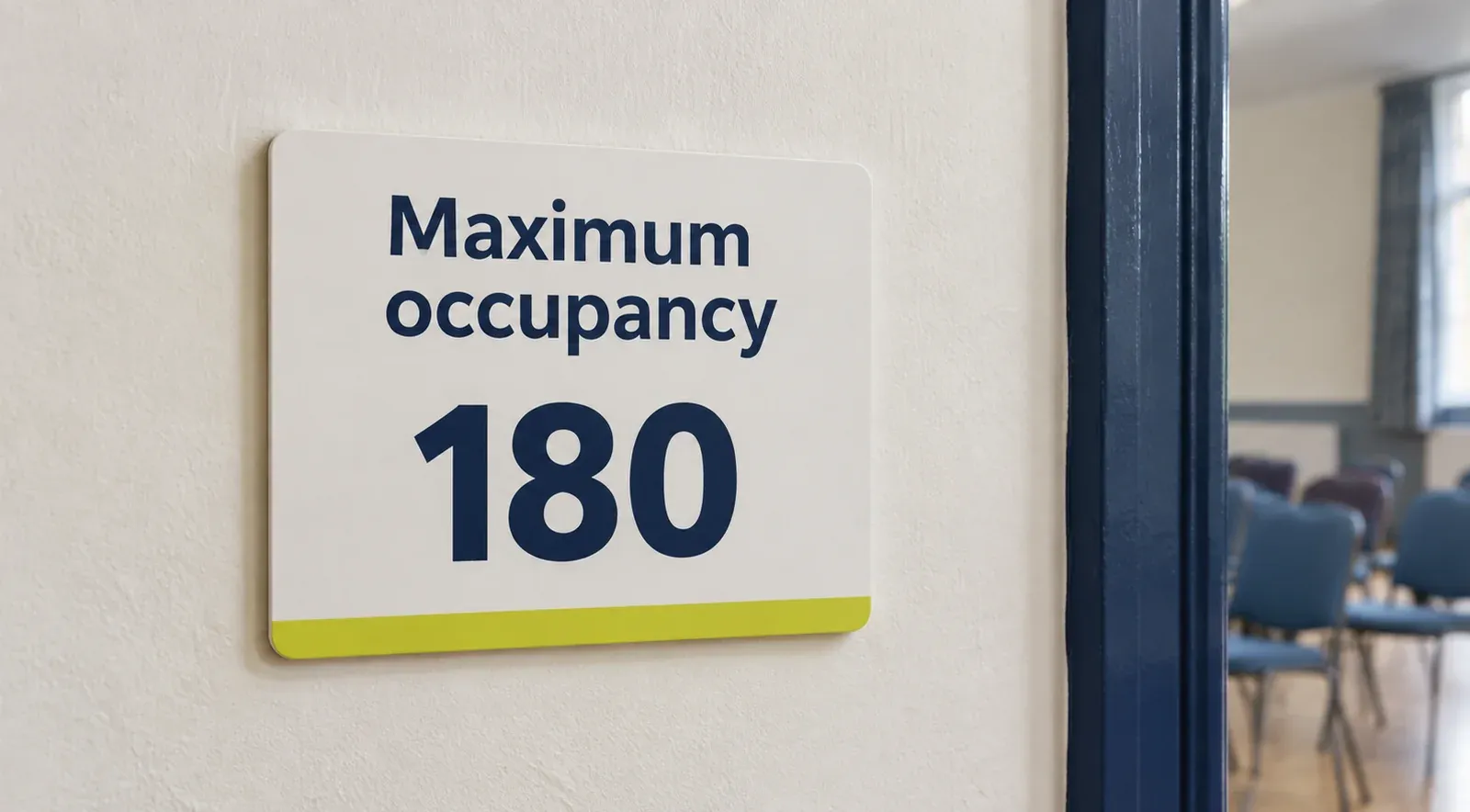
The fire risk assessment gives a safe occupancy of 180.
Most bookings are small: a toddler group of 25, a yoga class of 15. The busiest event is a wedding reception of 150 guests, plus caterers and a band.
The hall never goes over its fire limit, so it can't reasonably expect 200.
Likely not in scope. That matches the Home Office's own estimate that only around 800 village halls will meet the threshold (Home Office impact assessment, Table 1).
A place of worship
Regular weekly gatherings bring about 120 people, volunteers included.
At the main festivals of the year (Christmas, Eid, Diwali or Vaisakhi, depending on the faith) attendance reaches about 320. Those festivals happen every year, so the threshold is met from time to time.
In scope, standard tier. Places of worship stay in the standard tier even above 800, when worship is the building's main use (GOV.UK scope factsheet).
A pub
Seventy people on a normal weeknight.
On big match nights the bar, function room and beer garden together hold around 240, with eight staff on. Big matches come round several times a season.
In scope. Outdoor areas that are part of the premises count. In the Home Office's café example, 30 outdoor seats are added to the indoor figure (Supplementary Document A, para 14).
A one-off
A community centre normally peaks at about 150.
It hosts a memorial that draws 260, the only time in 15 years it has been that busy.
A genuine one-off, so not in scope on that basis alone. If events like that start happening regularly, it's time to count again.
Write it down
You don't have to send your calculation anywhere.
But the regulator, the Security Industry Authority (SIA), can ask how you worked it out (Supplementary Document A, para 4). A short note is enough:
- the number you arrived at, and the date
- the method you used (for example, attendance records from the last two years)
- your busiest occasions and how many were there, including staff and volunteers
- who did the count
- when you'll look at it again
Our free busiest day calculator adds up each occasion for you and prints a worksheet you can keep as that note.
Your number can change. The guidance says it "may change over time and so should be kept under review" (Pinsent Masons summary of the Home Office guidance).
A new regular event, a busy run of bookings or a change in how the building is used are all good reasons to count again.
If you're at 200 or more, what next?
Between 200 and 799 you're in the standard tier, and the duties are modest.
You tell the SIA who's responsible for the premises. And you have procedures for four things, so far as reasonably practicable: evacuation, invacuation (bringing people inside to safety), lockdown and communication.
There's no requirement for physical security such as bag searches or CCTV (ProtectUK overview).
At 800 or more, most premises move to the enhanced tier. That asks for more and usually needs specialist help.
None of this is in force yet. The SIA expects the duties to start in spring 2027 and will confirm the date (SIA).
So there's time to get your number right calmly, rather than in a rush.
Questions people ask
Do volunteers count towards the 200? Yes. The guidance counts employees, contractors and volunteers.
Does our car park or garden count? Count the parts of the premises used for the listed purposes. A beer garden where customers sit and drink is part of a pub's food and drink use.
The immediate surroundings outside your premises aren't counted (Supplementary Document A, para 11).
We hit 200 once a year. Are we in? Probably, if it's a regular yearly event such as a festival, a fair or a big annual service.
A genuine one-off that you didn't expect and won't repeat doesn't count.
Can we use our licence limit? Yes, if you work to it. Licence conditions are method E.
If the limit only covers customers, add your staff on top.
What if we're not sure? Pick the method that best reflects reality, write down your reasoning and review it now and then.
The SIA is also building an online scope checker, due in early 2027.
About this guide: it's based on the Home Office's non-statutory Supplementary Document A on assessing numbers (April 2026), the GOV.UK scope factsheet and ProtectUK guidance, read on 2 and 3 November 2026. The worked examples are our own illustrations. This is general guidance, not legal advice, and the duties aren't in force yet, so details may change. We'll update this page when the SIA publishes its scope tool and templates.
Want to check your venue? hailo's free scope check walks you through these questions in about two minutes, with no account needed. Check your venue free
Sources
- Home Office, Terrorism (Protection of Premises) Act 2025: Non-statutory Supplementary Document A
- GOV.UK, Terrorism (Protection of Premises) Act 2025: scope (premises) factsheet
- ProtectUK, Reasonable figure and Martyn's Law overview
- Security Industry Authority, Understanding Martyn's Law and the SIA's role as regulator
- Home Office, Terrorism (Protection of Premises) Bill impact assessment
- Pinsent Masons, Home Office publishes Martyn's Law venue guidance
General information, not legal advice.